English original 
Automated Translation: 
 
 
METROBITS - The world's subways unearthed.METROBITS - The world's subways unearthed.


Printer-friendly Printer-friendly


Schematic Maps


The world-wide success of a design classic


Schematic Maps main page
All Schematic maps — sorted alphabetically
All Schematic maps — sorted by number of stations
Comparing Maps — schematic vs. to-scale


Until the 1930s, official maps of the fast growing metro networks in the big cities were mostly topographical and increasingly cluttered. Something had to be done to make them clearer. In 1933, the draughtsman Harry Beck came up with a schematic map for London Underground that resembled the diagram of an electronic circuit with its straight lines and 45° angles. The simple design had been so efficient and popular that in the following decades, nearly all urban transportation systems around the globe have adopted this style for their official maps.

The station density in the city centre is usually much higher than in the suburbs, so tagging every station with a name becomes a problem in the design of to-scale maps. Schematic maps get around this problem by blowing up the city centres and shortening the radial lines. This makes them more compact, while straightening the lines and omitting geographical details makes them much easier to read.

The 'map' and '©' links below the maps lead to the original versions.

Disclaimer: Maps are copyrighted. The thumbnails on this page are for informational purposes only. Please respect copyright and always refer to original maps.


The first diagrammatic map

London Underground had more or less cluttered geographic Tube maps until Henry C. Beck (also known as Harry Beck) developed a diagrammatic map in 1933 [1]. Beck's thoroughly composed map design combines the clarity of straight lines with the use of basic colours. It has highly influenced the map designs of most metros and subways around the world.

Source: map (jpg), © tfl.gov.uk

London's modern map

The latest descendant of Harry Beck's classic. Though lines have altered since, style and usability remain almost unchanged.

Source: map (gif), © 2011 tfl.gov.uk

Moscow's circular beauty

In the Moscow map, the circular ring line and the angles of the other lines are contrasting nicely as the Koltsevaya ring line strikingly breaks with the 45° rule. All metro systems with ring lines should consider doing their maps like this (at least when the geography allows it, unlike the complicated, elongated circle in London). The only other known example is Nanjing's map with an ovoid depiction of its circle line.

Source: map (html), © 2007 engl.mosmetro.ru

A rather uninspired ring design

Maybe map designers should be more courageous when it comes to circle lines: the Oslo map, as well as the maps of many other metros, could probably look as excellent as Moscow's if the ring wasn't forcefully pressed into the 45° scheme.

Source: map (pdf), © 2010 tbane.no

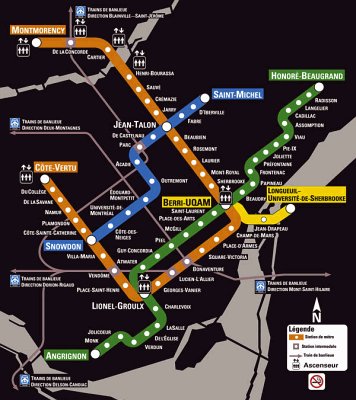
Montreal's black beauty

The diagram on the black background looks elegant, but everybody who wants to print it at home will probably hate to waste that much ink.

Source: map (pdf), © 2011 stm.info

Madrid's rectangular diagram

Madrid's current map proves that using only 90° angles does not enhance usability.

Source: map (pdf), © 2011 metromadrid.es

New York's resisting the diagram

New York is the world's only major metro system currently without a diagrammatic map. Official maps have been diagrammatic from 1958 but switched back to freestyle in 1979 [3]. The current map is rich in geographic details yet not to scale. Critical voices are becoming louder recently and several suggestions have been made for diagrammatic maps.

Source: map (html), © 2011 mta.info

Kyoto's strength of symbolism

Coincidence or intention? The schematic map of the emperor's city is close enough to geography but at the same time strongly resembles a Japanese "ryoku" or Chinese "li" character, meaning "strength, power".

Source: map (gif), © 2008 city.kyoto.jp


Schematic Maps main page
All Schematic maps — sorted alphabetically
All Schematic maps — sorted by number of stations
Comparing Maps — schematic vs. to-scale


Reference

[1] Design Classics. Transport for London.

[2] Garland, Ken: Mr. Beck's Underground Map. Capital Transport 1994.

[3] Ovenden, Mark: Metro Maps of the World, 2nd Edition. Capital Transport 2005.

[4] Wikipedia: Tube Map


Last update to this page: 28 Sep 2011.


Feedback


Bookmark and Share

This page: http://mic-ro.com/metro/schematicmaps.html

© 2004-2012 metrobits.org


HomeCity PagesWorld Metro DatabaseMetro Arts & ArchitectureMetro LogosResourcesForumAbout

 
Browse by city:

Adana Algiers Almaty Amsterdam Ankara Antwerp Athens Atlanta Baku Baltimore Bangalore Bangkok Barcelona Beijing Belo Horizonte Berlin Bielefeld Bilbao Bochum Bonn Boston Brasilia Brussels Bucharest Budapest Buenos Aires Buffalo Bursa Busan Cairo Caracas Catania Changchun Charleroi Chengdu Chennai Chiba Chicago Chongqing Cleveland Cologne Copenhagen Daegu Daejeon Dalian Delhi Detroit Dnepropetrovsk Dortmund Dubai Duesseldorf Duisburg Edmonton Essen Frankfurt Fukuoka Gelsenkirchen Genoa Glasgow Guadalajara Guangzhou Gwangju Haifa Hamburg Hangzhou Hanover Helsinki Hiroshima Hong Kong Incheon Istanbul Izmir Jacksonville Kamakura Kaohsiung Kazan Kharkov Kiev Kitakyushu Kobe Kolkata Kryvyi Rih Kuala Lumpur Kyoto Las Vegas Lausanne Lille Lima Lisbon London Los Angeles Ludwigshafen Lyon Madrid Manila Maracaibo Marseille Mashhad Mecca Medellin Mexico City Miami Milan Minsk Monterrey Montreal Moscow Mulheim Mumbai Munich Nagoya Naha Nanjing Naples New York Newark Newcastle Nizhny Novgorod Novosibirsk Nuremberg Oporto Osaka Oslo Palma de Mallorca Paris Perugia Philadelphia Pittsburgh Porto Alegre Poznan Prague Pyongyang Recife Rennes Rio de Janeiro Rome Rotterdam Rouen Saint Louis Saint Petersburg Samara San Francisco San Juan Santiago Santo Domingo Sao Paulo Sapporo Seattle Sendai Seoul Seville Shanghai Shenyang Shenzhen Singapore Sofia Stockholm Stuttgart Suzhou Sydney Taipei Tama Tashkent Tbilisi Tehran The Hague Tianjin Tokyo Toronto Toulouse Turin Valencia Valencia Valparaiso Vancouver Vienna Volgograd Warsaw Washington Wuhan Wuppertal Xi'an Yekaterinburg Yerevan Yokohama